Free shipping over 499kr


Plant-dye your hair at home with Plants In Colour
PLANT COLOR, THE BASICS!
Plants in Colour - Green Head's own plant colour series makes it more fun and easier than ever to step into the fantastic world of plant colours. With both mixed pigments and pure pigments, the series allows freedom and playfulness in your creation, whether you are an experienced plant colourist or curious to start. With its natural ingredients, Plants in Colour also moisturizes the hair and gives it a wonderful shine and a fantastic lasering depth of colour.
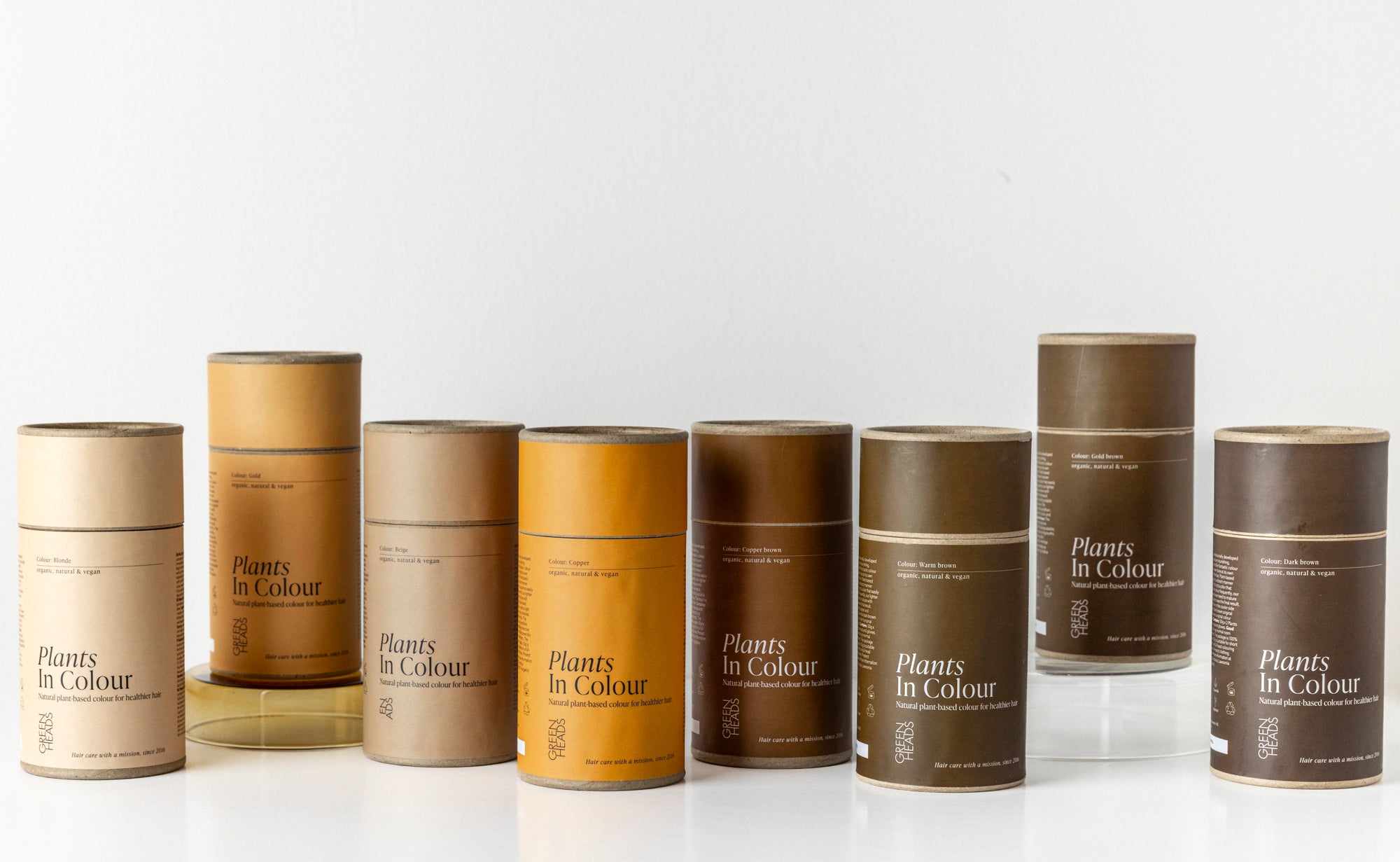
The Plants In Colours colour chart is divided into:
8 Mixed pigments - 4 light and 4 dark
2 Pure pigments -Henna and Indigo
1 Strong pigments - Red
3 Plants In Gloss - 3 pcs in the shades Nude, Cognac and Mocca
PLANTS IN COLOUR - COLOUR CHART

Some things you need to know about plant color before you get started are:
Indigo is a blue pigment that we use primarily to darken, dampen coppery tones and to produce brown shades. If you bleach brown hair that has been previously dyed with indigo, the hair will turn a light blue-green. Pure Indigo and our dark mixtones that contain a larger proportion of Indigo are therefore suitable for those who consider themselves brunettes and do not want or usually bleach their hair . Our light plant color mixes, on the other hand, can be bleached and can be easily lightened 2-3 steps.
Plant color gives a lasered result, you can compare it to regular paint. Where plant color is like painting with watercolor and synthetic color is more like painting with a covering acrylic paint. You can get really nice results even on gray hair. Instead of a full-coverage "color helmet" that is easy to get with chemical hair color, Plants in Color gives a nice lasered effect that is vibrant and natural as the hair's natural shades shine through. It also gives a softer growth which means you can wait a little longer between colorings.
If you have previously dyed your hair with "regular" chemical dye and want to switch to plant-based dye, that's no problem, but it will be a process where the "seam" is more or less clear depending on how opaque your previous color was.
Herbal hair dye cannot lighten hair, but can only be dyed to the same or a darker lightness than you already have, and therefore the results are affected by the original color of the hair. The shade is also affected by other factors such as the hair's white content, quality, and whether your hair has previously been chemically treated, etc. With plant dye, the result is therefore individual and unique for each person.
The plant pigments need a few days to mature before the dyeing process can be considered completely complete, it can take up to 2-3 days. Some brown colors can give a slight green impression when they are freshly made, but this disappears after a few hours as the color matures.
How to think about color choices:
It is your starting point, desired color and intensity that determines what you can do and which color choice you should make. We recommend that if you are fair-haired and are going to dye your hair at home, you should stick to our light colors. If you want to go from light blonde to dark, you need to pre-pigment your hair and it is a process that is best done in a salon by a professional hairdresser and, as we mentioned before, cannot be reversed as you cannot bleach our dark tones. If you want to pre-pigment your hair yourself, we recommend that you use the tone Warm brown or the tone Henna for 15 minutes. The darker the desired end result, the warmer the pre-pigmentation. However, if you are dark-haired and want to get a different shade or go darker, our dark tones are perfect. However, our light tones will not make any noticeable difference to dark hair other than that the hair gets a little shine and a moisturizing treatment.
Mixed pigments
If you are light blonde, you can use all of our light color mixes. If you are medium blonde or dark blonde, you can use all of our mixtones. If you are brown-haired, you can use all of our dark mixtones (note, these cannot be bleached without getting a light blue-green result). If you are medium blonde with mostly gray hair, then you can use all of our mixtones.
Pure & Strong pigments
Are pigments that are very strong in their shade and are used to sharpen an already mixed pigment. For example, if you are medium blonde and choose our Warm brown color mix but want a slightly copperier touch, you can replace some of the warm brown powder with Henna, Red instead gives a slightly cooler red tone and Indigo dampens the warmth and makes the shade more neutral. But we cannot emphasize enough that you should be very careful with Indigo and only choose it if you are used to plant color and know what you are doing.
Plants In Treatment
We also have herbs without pigment, Plants In Treatment which is our caring and moisturizing treatment that we also use when coloring. We use it to dilute mixtones so they are not so intense/dark/overwhelming . For example, if you take some Beige and some Plants In Treatment you can get a very nice blonde shade that goes towards the sandy side and can be great on bleached strands.
Plants In Treatment is also perfect for adding to lengths that just need a moisturizing treatment that adds extra shine while coloring a growth.
PLANT COLOR - HOW TO GO TO THE WAY.
What do you need:
You will need a measuring cup or scale, a hand whisk, warm water, a paintbrush and a plastic bag. Gloves can also be a good idea as vegetable dye can stain your skin and nails.

How to mix the paint:
Mix 1 part Plants In Colour with 3 parts water, heated to 75 degrees, (note, do not use hot tap water as it may contain deposits from the pipes). It is best to weigh the powder as it can be too compact if you measure in, for example, a deciliter measure. 100 g of plant colour is a good guideline for normal-thick, shoulder-length hair. 50 g of plant colour can be enough for one regrowth. If you weigh your mixture for a full-hair colour, you should therefore take 100 g of plant colour and 300 g of 75-degree water. To colour a regrowth, you will instead use 50 g of plant colour and 150 g of 75-degree water. Mix everything to a creamy yoghurt-like consistency with a whisk and let the colour mixture cool to body temperature before application. Use all the colour immediately.
Applying the plant color using the cross technique :
Apply the warm color to freshly washed, towel-dried hair using the criss-cross technique, which simply means dividing your hair using a cross.
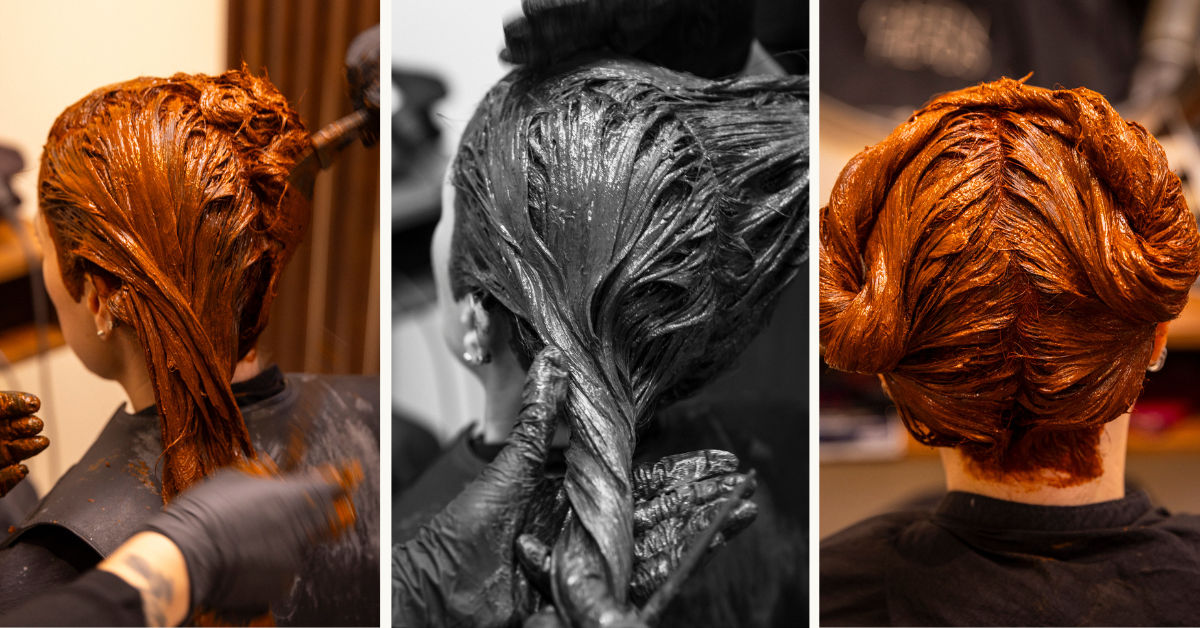
It helps you apply it to your entire hair so you don't miss anything. When coloring your entire hair, it's important that you really apply color to all of your hair, while when coloring your hair extensions, it's important that you get to the bottom of the hair properly, but don't color the lengths that have already been colored. Hair that has been colored in several layers can become darker, slightly dull, and very difficult to bleach because the hair is then over-pigmented. With the cross technique, you divide your hair into a cross, from ear to ear and from forehead to neck, which gives you four large pieces of cake. Start in the middle of the cross, take a passé of about 2 cm and start coloring (the whole hair or just the hair extensions), fold the passé towards the middle and take the next one until you've worked your way through each piece of cake. This applies if you have hair that is as light in the front as it is in the back.
If you have hair with large white areas at the front (gray) and you want to dye your hair a darker color , you should apply the lightest parts first. That's where the color needs to work the longest to cover. But if you have large white areas at the front (gray or bleached) and you want to dye your hair a lighter color , you do the opposite. Then you start at the back and finish at the front as you only want the light parts to get a lighter shade.
Once you have applied color to the sections of your hair that are to be colored, wrap a plastic bag over your hair and a hair towel over it. Make sure the bag really covers all of your hair and seals it so that no air gets in, the color needs to be moist and warm at all times to give an optimal and lasting result. The plastic bag also protects against color stains and the towel ensures that the color is kept warm.
Duration of action:
The exposure time varies depending on the initial condition, desired lightness level and intensity. For those who are going to dye a dark color, the color should be left on for between 60-90 minutes to get a permanent and covering result. For those who have a light initial condition and are going to add a light color, the color should be left on for between 15-30 minutes. If you have very white hair/blonde and use our beige color mix, it can go towards the copperier side with a longer exposure time. If you just want to get a beige touch, 5-10 minutes is enough, but this only applies to you with a very light initial condition.
End:
Rinse with lukewarm water, massage out the color and finish with conditioner. Avoid washing your hair within 48 hours for best color results.
If you are unsure about what paint to buy for a certain result in our webshop, contact us at kundservice@greenheads.se and we will help you.